

Q 11-13-007NEETNEET 2023Top questionMedium
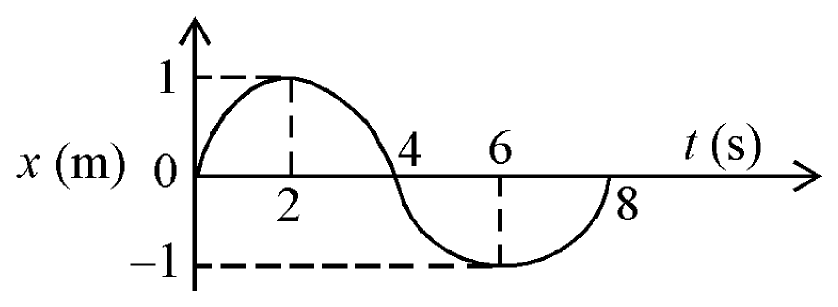
The $x$-$t$ graph of a particle performing simple harmonic motion is shown in the figure. The acceleration of the particle at $t = 2$ s is :
Answer: (D) $-\dfrac{\pi^2}{16}\ \text{m s}^{-2}$
From the graph: amplitude $A = 1$ m and period $T = 8$ s, so $\omega = \dfrac{2\pi}{8} = \dfrac{\pi}{4}$ rad/s and $x = \sin\left(\dfrac{\pi t}{4}\right)$.
At $t = 2$ s, $x = 1$ m (the positive extreme).
$$a = -\omega^2x = -\frac{\pi^2}{16} \times 1 = -\frac{\pi^2}{16}\ \text{m s}^{-2}$$
 Solution by Sreeraj P, M.Sc Physics