

A uniform disc of mass $0.5\ \text{kg}$ and radius $r$ is projected with velocity $18\ \text{m s}^{-1}$ at $t=0$ s on a rough horizontal surface. It starts off with a purely sliding motion at $t=0$ s. After $2$ s it acquires a purely rolling motion (see figure). The total kinetic energy of the disc after $2$ s will be ______ J. (given, coefficient of friction is $0.3$ and $g=10\ \text{m s}^{-2}$)
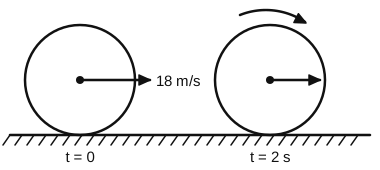
Numerical value type. Enter your answer.
Answer: 54
Friction $\mu mg$ slows the centre and spins the disc up:
$v=18-\mu gt=18-3t$, $\quad\omega r=\dfrac{\mu mg r}{\frac12mr^2}\,r\,t=2\mu gt=6t$.
Rolling starts when $18-3t=6t$, i.e. $t=2\ \text{s}$, with $v=12\ \text{m s}^{-1}$.
For a rolling disc $K=\tfrac12mv^2+\tfrac12\left(\tfrac12mr^2\right)\omega^2=\tfrac34mv^2=\tfrac34\times0.5\times144=54\ \text{J}$.
 Solution by Sreeraj P, M.Sc Physics