

Two blocks of masses $2$ kg and $1$ kg respectively, are tied to the ends of a string which passes over a light frictionless pulley as shown in the figure below. The masses are held at rest at the same horizontal level and then released. The distance traversed by the centre of mass in $2$ s is ______ m. (Take $g=10\ \text{m/s}^2$)
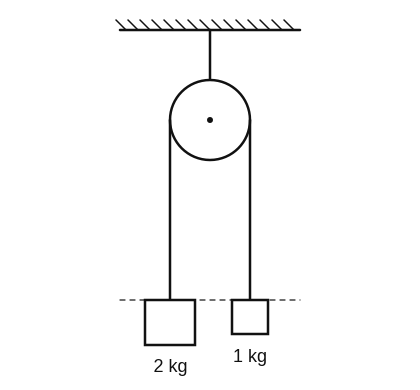
Answer: (C) $2.22$
Concept. The centre of mass of the two blocks moves with $a_{cm}=\dfrac{m_1a_1+m_2a_2}{m_1+m_2}$, where the accelerations are taken with signs. Here the blocks move in opposite directions, so their contributions partly cancel.
Step 1. Acceleration of each block (Atwood machine).
$$a=\frac{(m_1-m_2)g}{m_1+m_2}=\frac{(2-1)(10)}{3}=\frac{10}{3}\ \text{m s}^{-2}$$
The $2$ kg block goes down, the $1$ kg block goes up.
Step 2. Acceleration of the centre of mass (downward positive):
$$a_{cm}=\frac{2\left(\frac{10}{3}\right)+1\left(-\frac{10}{3}\right)}{3}=\frac{10}{9}\ \text{m s}^{-2}\ \text{(downward)}$$
Step 3. Distance in $2$ s from rest. Both blocks start at rest, so the centre of mass does too:
$$s=\tfrac12a_{cm}t^2=\tfrac12\cdot\frac{10}{9}\cdot4=\frac{20}{9}=2.22\ \text{m}$$
Answer. $2.22$ m (Option C). Shortcut: for an Atwood machine $a_{cm}=\left(\dfrac{m_1-m_2}{m_1+m_2}\right)^2g$.
 Solution by Sreeraj P, M.Sc Physics


