

In the given figure, a mass $M$ is attached to a horizontal spring which is fixed on one side to a rigid support. The spring constant of the spring is $k$. The mass oscillates on a frictionless surface with time period $T$ and amplitude $A$. When the mass is in equilibrium position, as shown in the figure, another mass $m$ is gently fixed upon it. The new amplitude of oscillation will be:
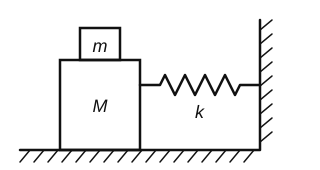
Answer: (D) $A\sqrt{\frac{M}{M+m}}$
At the equilibrium position $M$ moves with its maximum speed $v = A\omega = A\sqrt{k/M}$. Adding $m$ gently conserves momentum:
$$Mv = (M+m)v' \;\Rightarrow\; v' = \frac{M}{M+m}A\sqrt{\frac{k}{M}}$$
The equilibrium position is unchanged, so $v'$ is the new maximum speed and $v' = A'\sqrt{\dfrac{k}{M+m}}$:
$$A' = \frac{M}{M+m}A\sqrt{\frac{M+m}{M}} = A\sqrt{\frac{M}{M+m}}$$
 Solution by Sreeraj P, M.Sc Physics