

Q 12-04-162JEE MainJEE Main 2021 (27 Jul, Shift 2)Medium
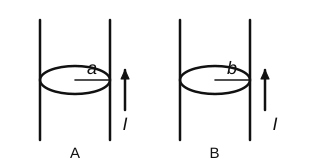
Figure $A$ and $B$ show two long straight wires of circular cross-section ($a$ and $b$ with $a < b$), carrying current $I$ which is uniformly distributed across the cross-section. The magnitude of magnetic field $B$ varies with radius $r$ and can be represented as:
Answer: (C) see figure
Inside a wire ($r < R$): $B = \dfrac{\mu_0Ir}{2\pi R^2}$, a straight line through the origin; its slope is larger for the thinner wire $a$.
At the surface: $B = \dfrac{\mu_0I}{2\pi R}$, which is larger for $a$ (peak at smaller $r$, higher).
Outside: $B = \dfrac{\mu_0I}{2\pi r}$ for both, so the two curves coincide for $r > b$. The peak of $b$ lies on the falling curve of $a$. This is graph (3).
 Solution by Sreeraj P, M.Sc Physics