

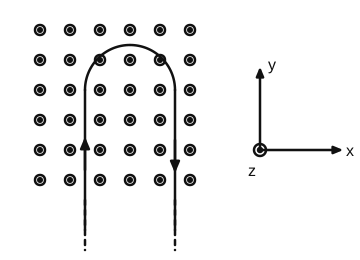
A rigid wire consists of a semicircular portion of radius $R$ and two straight sections. The wire is partially immersed in a uniform magnetic field $\vec B = B_0\hat k$ (out of the page), as shown in the figure. The two straight sections run parallel to the $y$-axis and extend out of the field region at the bottom. If the wire carries a current $i$ (up the left section and down the right section), the magnetic force on the wire is:
Answer: (D) $-2iBR\,\hat j$
In a uniform field the force on a wire depends only on the straight line joining the points where the current enters and leaves the field region. The current enters at the bottom of the left section and leaves at the bottom of the right section, which are $2R$ apart along $+x$:
$$\vec F = i(2R\,\hat i)\times(B_0\hat k) = 2iRB_0(\hat i\times\hat k) = -2iB_0R\,\hat j$$
 Solution by Sreeraj P, M.Sc Physics