

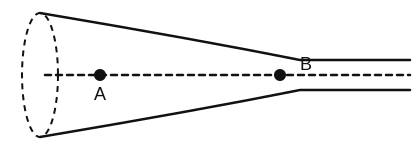
The figure shows a liquid of given density flowing steadily in horizontal tube of varying cross-section. Cross-sectional areas at $A$ is $1.5\ \text{cm}^2$ and $B$ is $25\ \text{mm}^2$. If the speed of liquid at $B$ is $60\ \text{cm s}^{-1}$ then $(P_A-P_B)$ is (Given $P_A$ and $P_B$ are liquid pressures at $A$ and $B$ points. Density $\rho=1000\ \text{kg m}^{-3}$. $A$ and $B$ are on the axis of tube)
Answer: (C) $175\ \text{Pa}$
Concept. Continuity gives the speed at $A$; Bernoulli for a horizontal tube gives $P_A-P_B=\tfrac12\rho(v_B^2-v_A^2)$. Higher speed means lower pressure.
Step 1. Speed at $A$. $A_A=150$ mm$^2$, $A_B=25$ mm$^2$:
$$v_A=0.6\times\frac{25}{150}=0.1\ \text{m s}^{-1}$$
Step 2. Bernoulli.
$$P_A-P_B=\frac12(1000)(0.6^2-0.1^2)=500\times0.35=175\ \text{Pa}$$
Answer. Option C.
 Solution by Sreeraj P, M.Sc Physics


