

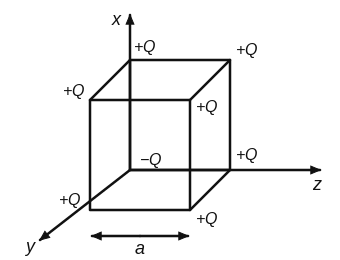
A cube of side $a$ has point charges $+Q$ located at each of its vertices except at the origin where the charge is $-Q$. The electric field at the centre of cube is:
Answer: (C) $\frac{-2Q}{3\sqrt3\pi\varepsilon_0a^2}(\hat x+\hat y+\hat z)$
Concept. Superposition trick: $-Q$ at the origin equals $+Q$ plus $-2Q$. Eight equal $+Q$ charges at the corners give zero field at the centre (symmetry), so only $-2Q$ at the origin remains.
Step 1. Distance. Centre to corner: $\dfrac{\sqrt3a}{2}$, so $r^2=\dfrac{3a^2}{4}$.
Step 2. Magnitude. $\dfrac{2Q}{4\pi\varepsilon_0}\cdot\dfrac{4}{3a^2}=\dfrac{2Q}{3\pi\varepsilon_0a^2}$.
Step 3. Direction. Towards the negative charge, i.e. along $-(\hat x+\hat y+\hat z)/\sqrt3$.
Answer. $\dfrac{-2Q}{3\sqrt3\pi\varepsilon_0a^2}(\hat x+\hat y+\hat z)$ (Option C).
 Solution by Sreeraj P, M.Sc Physics


